
Posted by James Crowley on 8/13/2026 to
LED Stadium Lights
Good sports lighting must make the field, players, lines, and ball easy to see without creating harsh brightness that interferes with vision. Simply adding more light does not solve every visibility problem. Fixtures that are too bright, poorly aimed, or fitted with the wrong optics can become a hazard.
A well-designed LED sports lighting system places useful illumination where athletes need it while keeping high-intensity light out of common viewing angles. That balance supports safer play, better concentration, and a more comfortable experience for everyone at the facility.
What Is Glare in Sports Lighting?
Glare is a visual condition caused by brightness that is excessive compared with the level to which the eyes have adapted. Useful brightness improves visibility and contrast. Excessive brightness creates distracting hotspots or a veil of light that makes details harder to distinguish.
Sports facilities may encounter four forms of glare:
- Direct glare comes from looking toward a bright fixture, often while tracking a high ball.
- Reflected glare occurs when light bounces from a glossy court, wet turf, ice, seating, or another reflective surface.
- Disability glare scatters light inside the eye and reduces the ability to see objects or contrast.
- Discomfort glare causes irritation or strain even if it does not produce an obvious loss of vision.
The International Commission on Illumination explains that disability glare can affect visual tasks, while discomfort glare can feel unpleasant without causing a directly measurable reduction in visibility.

Why Glare Is a Safety Concern
Athletes constantly shift their gaze between bright fixtures, darker backgrounds, teammates, markings, and fast-moving objects. A glaring LED sports light can make those rapid visual adjustments more difficult.
Reduced Ball Visibility
Baseballs, softballs, soccer balls, and other moving objects can cross the visual path of a fixture. If the light source is dazzling, a player may briefly lose the ball or see reduced contrast around it.
A CIE sports lighting study reported complaints from professional baseball players who missed routine fly balls and line drives because of strong glare. This shows why total brightness alone is not a reliable measure of lighting quality.
Increased Risk of Injury
Losing sight of the ball for even a moment can delay a defensive move or cause a missed catch. Reduced visibility may also contribute to player collisions or make field obstacles and boundaries harder to detect. Lighting cannot eliminate every sports injury, but it should not add an avoidable visual obstacle.
Eye Fatigue During Games
Repeated exposure to intense brightness can cause squinting, visual discomfort, and tired eyes. Over a long game or practice, that strain can reduce concentration and hurt performance.
Common Causes of Glare in LED Sports Lighting
Glare usually reflects a system-level design problem rather than one bad fixture. Common causes include:
- Fixtures tilted too far toward players or spectators
- A beam angle that does not match the pole height and throw distance
- More lumen output than the application requires
- Poles that place fixtures too low for the selected aiming angle
- Bright hotspots located beside dark patches
- An outdated layout reused without accounting for LED optics
Replacing old equipment with higher-output fixtures in the same positions may preserve the original layout’s problems. Each fixture, pole, mounting height, aiming point, and target light level must work as part of one system.
Select the Correct Beam Angle
Beam angle controls how widely a fixture distributes its light. Selection depends on pole height, setback, aiming distance, field dimensions, and the required illumination pattern.
Narrow Beam Optics
Narrow beams concentrate light for a longer throw. They are often used on taller poles or where fixtures must reach distant parts of a large field. Careful aiming matters because a concentrated beam can create hotspots if it lands in the wrong place.
Medium Beam Optics
Medium beams balance reach and coverage. They can work well across many athletic fields, especially where poles sit at moderate heights and distances from the playing surface.
Wide Beam Optics
Wide beams spread light across a larger nearby area. They are commonly suited to lower mounting heights, shorter throws, and smaller courts or facilities.
A wide beam is not automatically low glare. It can still cause discomfort if bright light enters a player’s line of sight.
Combining Beam Angles
Many successful layouts use more than one optic. Narrow beams can reach the center or far side, while medium or wide beams fill closer areas. This layered approach improves uniformity without relying on excessive output from every fixture.
Use Photometric Lighting Plans Before Installation
A photometric plan models the proposed lighting system before crews install poles and fixtures. Using manufacturer IES files, the designer can evaluate fixture output, light distribution, mounting height, tilt, orientation, and aiming points.
The plan maps predicted footcandle levels and shows whether the field will meet the appropriate target and uniformity ratio. Requirements differ among recreational, competition, and broadcast facilities, so there is no universal footcandle target. Current guidance such as ANSI/IES RP-6-24 should inform the design.
Photometric planning can also identify glare risks from typical player positions, improve pole placement, and uncover dark areas or hotspots. Correcting these issues in a model costs far less than moving poles or re-aiming an entire system after installation.
A final field inspection and light-level measurements remain important because actual site conditions may differ from the computer model.
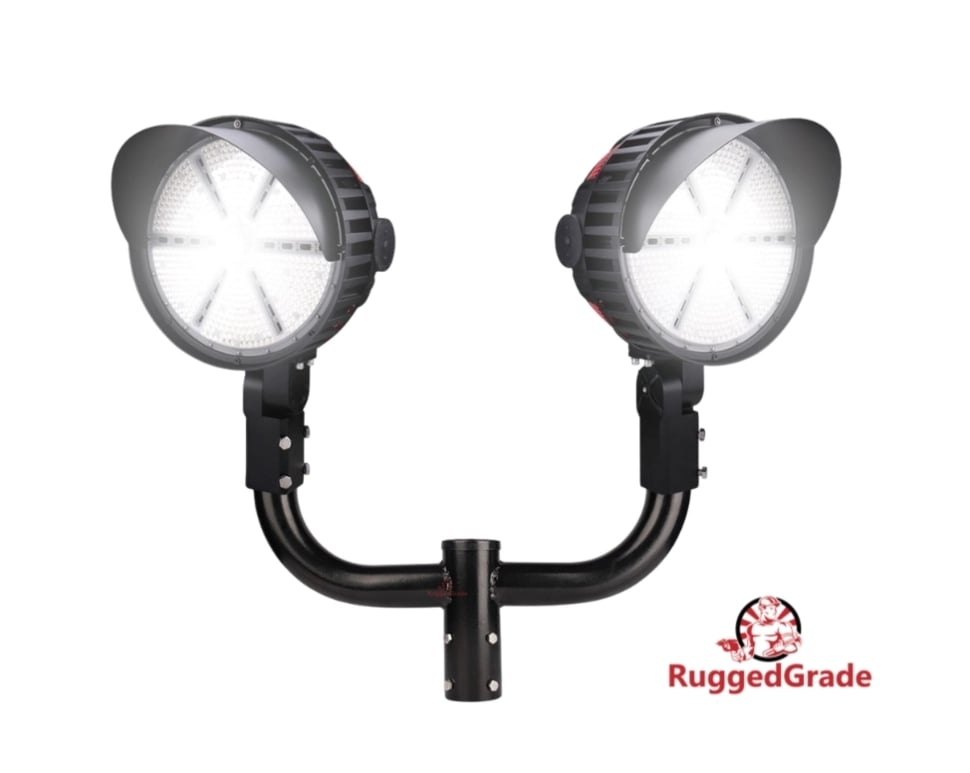
Upgrade From Metal Halide to LED Sports Lighting
A properly designed LED upgrade can offer tighter optical control and more even distribution than a legacy metal halide system.
Individual LED optics direct light toward the playing surface rather than wasting it above the field or outside its boundaries. Better uniformity and less overlighting can both help control glare.
LED fixtures also turn on instantly. Metal halide systems generally require warm-up time and may need time to restrike after a power interruption. LEDs avoid that delay and work more readily with lighting controls.
Their long service life can also reduce lamp changes and maintenance visits on tall poles. This can lower labor and equipment costs over the life of the system.
These advantages depend on good product selection and planning. An LED retrofit should be designed around required light levels, optics, pole conditions, electrical compatibility, and glare control. It should not be treated as a simple watt-for-watt fixture swap.
Safer Visibility Starts With Better Light Control
Reducing glare is not about making a field dimmer. It is about placing the right amount of light where visual work happens and limiting brightness elsewhere. Correct beam angles, suitable mounting heights, careful aiming, balanced illumination, and a detailed photometric plan turn LED sports lighting into a safety tool instead of a distraction.
The best results come from treating the field as a complete visual environment. A thoughtfully selected LED sports light can improve ball tracking, reduce eye strain, support faster reactions, and provide consistent visibility from the opening whistle to the final play.
About the Author: About James Crowley on X.
About us: See our About us page for more about RuggedGrade
